
Appearance
Unit 1 · Atomic structure
Atoms, periodic table and reactions · Year 10 Science · Science understanding
Topic hub: Overview · Next unit: Periodic table and trends
This unit matches structure of atoms ideas in the science understanding topic (see curriculum checklist). It prepares you for periodic trends (Unit 2) and reactions (Units 3–4).
1. What you should be able to do
- Describe the nuclear model: dense nucleus plus electrons outside it.
- Use atomic number (Z) = number of protons to identify an element.
- Explain neutral atoms, cations and anions using proton/electron counts.
- Describe isotopes as same element, different neutron count; same chemistry, different mass.
- Use a shell model: valence electrons are in the outer shell and matter most for bonding and reactivity.
2. Subatomic particles — the basics
| Particle | Relative charge | Where it lives | Role in Year 10 stories |
|---|---|---|---|
| Proton | +1 | Nucleus | Count = atomic number; defines the element |
| Neutron | 0 | Nucleus | Adds mass; isotopes differ by neutron count |
| Electron | −1 | Outside nucleus | Chemical behaviour; neutral atom: same count as protons |
Mass: almost all the atom’s mass is in the nucleus (protons + neutrons). Electrons contribute very little mass but control how atoms interact.
3. Diagram — shells around a nucleus
The picture below is schematic. Real atoms are not tiny “planets”; this model is a teaching picture for energy levels (shells) and where valence electrons sit.
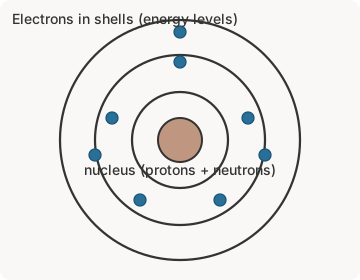
Read the diagram:
- Nucleus: protons and neutrons (not drawn separately here).
- Shells: each “ring” is a higher energy level farther from the nucleus in this simple view.
- Valence electrons: electrons in the outer occupied shell — the ones involved first in bonding and many reactions.
4. Atomic number, mass number and symbols
- Atomic number Z = number of protons. If you know Z, you can read the element from the periodic table.
- Mass number A (often used at school) = protons + neutrons in one nucleus (one isotope).
- Neutral atom: electrons = protons. Ion: unequal counts → overall charge.
Example: chlorine has Z = 17. A neutral chlorine atom has 17 electrons. A chloride ion Cl⁻ has gained one electron → 18 electrons, still 17 protons → charge 1−.
5. Isotopes
Isotopes are atoms of the same element (same Z) with different numbers of neutrons (different A).
- Chemical properties stay very similar because chemistry is mostly about electrons, especially valence electrons.
- Physical properties that depend on mass (density of an element, diffusion rates of gases, etc.) can differ slightly.
The relative atomic mass on the periodic table is a weighted average over naturally occurring isotopes — that is why it is often not a whole number.
6. Your turn
Q1. An atom has 11 protons and 10 electrons. Is it neutral? If not, what is the charge and what is a likely symbol for the ion?
Sample answer
Not neutral: one fewer electron than protons → 1+ cation. Z = 11 is sodium → Na⁺.
Q2. In one sentence, why do carbon-12 and carbon-14 both show carbon chemistry in most school contexts?
Sample answer
They are isotopes: same number of protons (same element) and the same electron arrangement in a neutral atom, so valence-level chemistry is essentially the same (differences matter in nuclear physics and dating, not in basic bonding patterns).
Q3. Point to two features of the nuclear-model diagram that are simplifications of real quantum behaviour.
Sample answer
Any two of: electrons drawn on fixed rings (not fuzzy orbitals); paths implied as circles; shells shown evenly spaced; nucleus drawn as a ball without separate protons/neutrons; implied that you can know exact positions — real electrons are described by probability distributions.