
Appearance
Unit 4 · Interaction pairs (third law)
Motion and forces · Year 10 Science · Science understanding
Topic hub: Overview · Previous: Force, mass and acceleration · Next: Quiz — motion and forces
Newton’s third law is about pairs of forces between two objects. It is easy to confuse with balanced forces on one object (first law) — this unit separates those ideas.
Try it first
Two carts, one line: Push the right cart and watch the collision. Each cart feels a force from the other — same size, opposite direction, on different bodies. Then read on to see why those two forces are not what you add for on one cart.
Interactive: third-law forces on two carts
The right cart moves in and pushes the left cart. Use a preset to compare accelerations (loads masses and runs Push right cart), or set masses with the sliders. While they interact, each feels a force from the other: same size, opposite direction, different body — so you never add those two into one cart’s Fnet.
Loading interactive…
1. What you should be able to do
- State Newton’s third law and identify a third-law pair in a simple scenario.
- Explain why third-law partners are never added together when finding on one object.
- For a book on a table, name forces on the book and separate them from interaction pairs that involve other bodies.
2. Third law — interaction pairs
If body A exerts a force on body B, then B exerts a force on A that is:
- equal in magnitude
- opposite in direction
- the same type of force (e.g. both contact, both gravitational)
Each force in the pair acts on a different object.
3. Diagram — mutual push (two bodies)
SVG diagrams in this unit are schematic — arrow lengths are not always to scale unless stated.
Two carts (or any two bodies) push each other. The horizontal forces between them are equal in size and opposite in direction, and each acts on a different object.

Read the diagram
- A on B — force cart A exerts on cart B (to the right on B in this picture).
- B on A — force cart B exerts on cart A (to the left on A).
Do not add these two when finding on A alone — B on A belongs in that sum; A on B belongs in the sum for B.
4. Worked example — book on a horizontal table
Forces on the book (free-body thinking):
- Earth → book: weight downward.
- Table → book: normal force upward.
If the book is at rest and there is no other vertical force, on the book, so and are equal in size and opposite — they are not a third-law pair (they act on the same object).
Third-law partners (examples):
- Earth pulls book ↔ book pulls Earth (both gravitational).
- Table pushes book ↔ book pushes table (both contact).
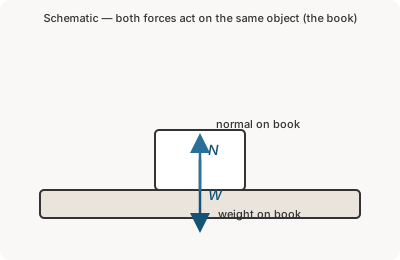
Read the diagram
- — gravitational pull of Earth on the book (down).
- — contact push of the table on the book (up).
When the book is at rest on a horizontal table with no other vertical forces, and have equal magnitude — they are balanced on the book. The third-law partners are different pairs (book↔Earth gravitationally; book↔table by contact).
Try it first used carts; this example uses a book — same rule: third-law partners always act on two different objects. The mutual-push diagram in §3 matches the sim idea; this figure shows forces on one object only.
5. Common mix-up
“The weight of the book and the normal force are third-law pairs because they are equal and opposite.”
They are balanced forces on one object when the book is at rest on a horizontal table — third-law pairs always act on two different objects.
5. Your turn
Q1. You push a wall; the wall pushes you back. State one third-law pair, naming who exerts what on whom.
Sample answer
You push the wall (contact force on the wall) and the wall pushes you with an equal and opposite contact force — same type, different bodies.
Q2. A student adds weight and normal force on a book at rest and says “these are Newton’s third law.” Correct them in one or two sentences.
Sample answer
Both act on the same object (the book), so they can balance for — they are not a third-law pair. A third-law partner to weight is book attracts Earth (gravitational pair).
Q3. A 50 kg rider on a kart has net horizontal force 200 N. Find . (This is second-law practice — which force belongs in here?)
Sample answer
. Use only forces acting on the rider (or on the kart, if the kart is your system) — not third-law partners acting on other things.