
Appearance
Unit 3 · Reaction types
Atoms, periodic table and reactions · Year 10 Science · Science understanding
Previous: Periodic table and trends · Topic hub: Overview · Next: Reaction rates
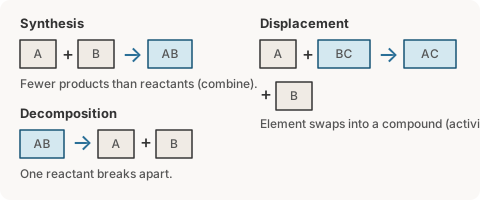
Chemistry is rearrangement of atoms. A few patterns cover many reactions you meet at Year 10: synthesis, decomposition and displacement (single replacement).
1. What you should be able to do
- Classify a reaction from a word or symbol equation when it fits the pattern.
- Write the pattern in symbols: , , .
- Explain displacement using relative reactivity (activity series for metals; halogen displacement patterns where taught).
- Remember: atoms are conserved — same atoms before and after, just rearranged (balanced equations reflect this).
2. Three core patterns
| Type | Word idea | Symbol skeleton |
|---|---|---|
| Synthesis (combination) | Two or more reactants → one product | |
| Decomposition | One reactant → two or more products | |
| Displacement | Element + compound → different element + different compound |
3. Worked examples — classify
Magnesium + oxygen → magnesium oxide
Synthesis — two substances form one compound.Hydrogen peroxide → water + oxygen (catalysed in many demos)
Decomposition — one reactant breaks into simpler products.Zinc + copper sulfate → zinc sulfate + copper
Displacement — zinc (more reactive metal in the usual series) replaces copper in the compound.
Ionic detail (if you write ionic equations): focus on the metal or halogen that swaps — your teacher will set the expected level.
4. What displacement is not
- Double displacement (two compounds swap partners) is common in precipitation reactions but is not the same as the single displacement pattern emphasised in AC9S10U07 at Year 10. If you meet , treat it as a separate pattern when classifying.
- Combustion (fuel + oxygen → oxides) is often taught as a special case of synthesis or as its own label — follow your class vocabulary.
5. Your turn
Q1. Classify: .
Sample answer
Decomposition — one compound forms two products.
Q2. Classify: .
Sample answer
Synthesis (combination) — two elements combine to form one compound.
Q3. Explain in one sentence why might not react if iron were less reactive than copper.
Sample answer
In displacement, the free metal must be more reactive than the metal in the compound so it can force it out — otherwise no swap occurs.