
Appearance
Unit 2 · Periodic table and trends
Atoms, periodic table and reactions · Year 10 Science · Science understanding
Previous: Atomic structure · Topic hub: Overview · Next: Reaction types
The periodic table is the chemist’s map: order (atomic number) and layout (periods and groups) line up with electron patterns and observable trends.
1. What you should be able to do
- Define period (row) and group (column) and read position for a given element.
- Explain why elements in the same group often behave like a chemical family (valence pattern).
- Describe atomic radius trends across a period and down a group at a descriptive Year 10 level.
- Connect metallic vs non-metallic character to table position in broad terms (metals left/bottom-ish; non-metals right/top-ish — your teacher may refine this).
2. How the table is organised
- Elements are ordered by atomic number Z (in the modern table).
- A period is a row: as you go across, the outer shell is filled stepwise (simple story — details belong in senior chemistry).
- A group is a column: main-group elements in the same group often share the same number of valence electrons in the simplified shell model.
That shared valence pattern is the main reason Group 1 metals or halogens show family resemblances.
3. Diagram — periods, groups, valence idea
Simplified grid (not a full periodic table poster):
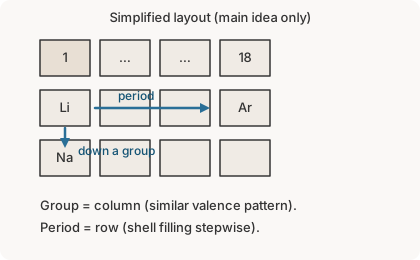
How to read it:
- Arrow along a period: atomic number increases; you are adding protons and electrons shell by shell across the row.
- Arrow down a group: each step adds a new occupied shell farther from the nucleus (again, this is the teaching picture).
Always use data from your practical work, textbook tables or exam data sheets when you justify a trend in an assessment.
4. Trends you should be able to tell as a story
These are Year 10 descriptive versions — your course may add ionisation energy and electronegativity with graphs.
Atomic radius
- Down a group: radius tends to increase — more occupied shells; outer electrons are farther from the nucleus on average.
- Across a period (left → right): radius tends to decrease — greater nuclear charge pulls the same shell inward more strongly in the simple explanation (effective nuclear charge story).
Reactivity patterns (broad)
- Alkali metals (Group 1): very reactive metals; reactivity tends to increase down the group (electron lost more easily from a shell farther out — teacher will link to data).
- Halogens (Group 17): reactive non-metals; patterns of displacement reactions use an activity or reactivity series you practise in class.
If your teacher gives a data booklet, practise reading numbers and linking them to position in the table.
5. Your turn
Q1. Sodium is in Group 1, Period 3. In the shell model, how many valence electrons does a neutral sodium atom have?
Sample answer
One valence electron (Group 1 main-group pattern in the simple model).
Q2. Argon is in Group 18. Why is it often described as unreactive in Year 10 contexts?
Sample answer
Noble gas outer shell is full (stable octet in the simple model), so it does not readily gain or lose electrons to form compounds under normal school conditions.
Q3. Without memorising exact numbers, state one trend for atomic radius as you move left to right across Period 3, and give a reason in words.
Sample answer
Radius decreases across the period because nuclear charge increases while electrons are added in the same principal shell, so the outer electrons are pulled closer (stronger attraction in the simple story).