
Appearance
Unit 2 · Mendelian inheritance
Heredity and evolution · Year 10 Science · Science understanding
Topic hub: Overview · Previous: Cell division and genetic material · Next: Natural selection and evidence
This unit uses simple inheritance patterns (one gene, complete dominance) — the level expected at Year 10 for predicting offspring from parent genotypes. It builds on genes and alleles from Unit 1: meiosis gives each gamete one allele per gene, and fertilisation brings two copies together again in the zygote.
Official checklist wording: Heredity and evolution (curriculum)
Try it first
Before the numbered outcomes, play with parent genotypes and watch how the Punnett grid and phenotype summary change. Then read the sections below and come back to check Aa × Aa, Aa × aa, and AA × aa with the presets.
Explore monohybrid crosses
Choose two parent genotypes for one gene with complete dominance (uppercase A dominant over a). The grid lists every equally likely zygote from combining gametes.
Loading interactive…
1. What you should be able to do
- Use phenotype and genotype language correctly for a monohybrid cross.
- List gametes a parent can make (for AA, Aa, or aa) for one gene.
- Use a Punnett square (or equivalent reasoning) to get 1 : 2 : 1 genotype ratios and 3 : 1 phenotype ratios for Aa × Aa when A is dominant.
- Interpret a test cross (heterozygote × homozygous recessive) as a way to reveal a hidden allele.
2. From parents to zygotes (one gene)
- A diploid parent has two alleles for a given gene (same letter, e.g. A and a).
- Meiosis puts one of those alleles into each gamete (for this Year 10 model, assume equal chances for A vs a when the parent is Aa).
- Fertilisation combines one gamete from each parent → the offspring’s two alleles for that gene.
Homozygous means both alleles match (AA or aa). Heterozygous (Aa) carries two different alleles; with complete dominance, the dominant allele’s trait usually shows in the phenotype.
3. Phenotype and genotype
- Genotype — the allele pair (e.g. Aa). Order is often written with the dominant letter first when one allele is dominant.
- Phenotype — what you observe (e.g. purple flowers, attached earlobe), which depends on genotype and sometimes environment. At Year 10 we often use traits where the simple dominant/recessive rule is enough.
One sentence
If A is dominant over a, then AA and Aa usually share the dominant phenotype; only aa shows the recessive phenotype (for that gene).
4. The Punnett square (monohybrid)
A Punnett square lists all combinations of one gamete from each parent. Each cell is one possible offspring genotype (assuming fertilisation is equally likely for each combo — a standard textbook model).
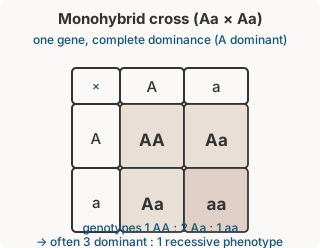
Diagram — Aa × Aa
Notice how margins show gametes and the inner grid shows zygotes. The aa cell is shaded differently to highlight the recessive homozygote (same convention as the interactive tool above).
Same cross as a table
Both parents are Aa for a trait where A is dominant.
| A | a | |
|---|---|---|
| A | AA | Aa |
| a | Aa | aa |
- Expected genotype ratio among many offspring: 1 AA : 2 Aa : 1 aa.
- Expected phenotype ratio (complete dominance): 3 dominant : 1 recessive (because AA and Aa look alike).
Takeaway: Ratios describe expectation over many offspring — one family’s children are not guaranteed to match 3 : 1 exactly.
5. Test cross (Aa × aa)
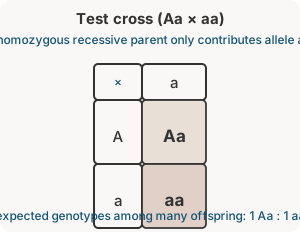
If an organism shows the dominant phenotype, its genotype might be AA or Aa. Crossing with aa (homozygous recessive) is a classic test cross: every offspring receives a from that parent, so:
- If the unknown parent is AA, all offspring are Aa (dominant phenotype).
- If the unknown parent is Aa, you expect 1 Aa : 1 aa (half dominant, half recessive phenotype) among many offspring.
Some textbooks repeat the a column twice (one slot per gamete). The diagram below uses one column labelled a, because the aa parent only contributes that allele type — the logic is the same.
6. Worked mini-example — AA × aa
Gametes: A only from parent 1, a only from parent 2 → all zygotes are Aa → all show the dominant phenotype in simple dominance. (This cross is in the Presets on the explorer.)
Self-check
1. A plant is heterozygous (Aa) for height and tall is dominant. State its phenotype and genotype in one line each.
Sample answer
Phenotype: tall (dominant trait shows). Genotype: Aa.
2. For Aa × Aa, what fraction of offspring are expected to be homozygous recessive?
Sample answer
1/4 are aa (one cell in four in the standard Punnett square).
3. Why is Aa × aa useful when you know one parent is aa but the other shows the dominant trait and its genotype is unknown?
Sample answer
The aa parent only passes a, so offspring genotypes directly reveal what allele the dominant-looking parent contributed (A → Aa, a → aa). Seeing aa offspring proves the dominant-looking parent carried a (was Aa).
More than Year 10 core (optional)
- Dihybrid crosses (two genes) and 9 : 3 : 3 : 1 ratios extend the same gamete × gamete logic — usually senior secondary.
- Incomplete dominance or codominance change how genotype maps to phenotype; the Punnett grid still works, but “3 : 1” may no longer apply.
- Linked genes on the same chromosome break the simple “independent assortment” story until you learn about recombination.