
Appearance
Unit 1 · Cell division and genetic material
Heredity and evolution · Year 10 Science · Science understanding
Topic hub: Overview · Next unit: Mendelian inheritance
This unit grounds heredity in what cells actually do: copying DNA, dividing, and making gametes. It also previews why that machinery matters for evolution in later units.
1. What you should be able to do
- Compare mitosis and meiosis and say what each is for.
- Link chromosomes, DNA, genes and alleles in one coherent explanation.
2. Two scales of the same story
- Heredity answers questions like: “Why do I share traits with my relatives?” Information is copied and packaged into gametes, then combined at fertilisation.
- Evolution by natural selection answers: “Why do species look different from their ancestors, and why do some traits become common in a population?” It needs heritable variation, differences in survival and reproduction, and many generations.
You do not need two unrelated memory banks. Sexual reproduction and meiosis help explain both family resemblance and variation that selection can act on — you will use that link again in Unit 3.
3. Cells, division and genetic material
Why two kinds of division?
- Mitosis — one cell becomes two genetically identical diploid body cells. Used for growth, repair and asexual reproduction in some organisms. Chromosome number stays the same (each daughter cell is 2n if the parent was 2n).
- Meiosis — one diploid cell (in ovaries/testes or plant equivalents) produces four haploid gametes (n chromosomes each). Crossing over and independent assortment shuffle alleles into new combinations.
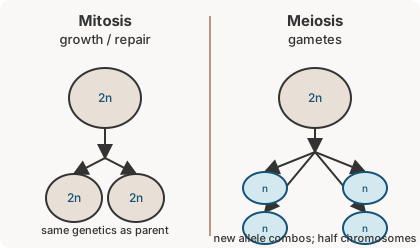
The diagram shows outcomes, not every stage — in class you may label prophase, metaphase, etc. Here, focus on 2n vs n and same vs new combinations.
| Mitosis | Meiosis | |
|---|---|---|
| Typical job | Growth, repair, some asexual reproduction | Producing gametes for sexual reproduction |
| Ends with | 2 cells, same ploidy as the parent (2n → 2n in diploid species) | 4 haploid cells (2n → n) in many animals and plants |
| Genetics | Daughter cells match the parent (barring rare errors) | New combinations of alleles (crossing over and independent assortment) |
Memory hook
Mitosis = Maintain (same genetics in somatic cells). Meiosis = Make gametes (half the chromosomes, new combos).
Chromosomes, DNA, genes, alleles
- A chromosome is a long DNA molecule packaged with proteins. Humans have pairs of chromosomes in body cells (one set from each parent).
- DNA is the chemical that stores instructions. A gene is a segment of DNA that usually codes for a product (often a protein) that influences a trait.
- Alleles are different versions of the same gene (e.g. allele for purple flowers vs white). An organism is homozygous if both alleles match, heterozygous if they differ.
Common mix-up
Dominant means “shows in the phenotype when only one copy is present (in a simple dominant/recessive pair).” It does not mean stronger, healthier or more common in nature. Recessive can still be passed silently through heterozygotes.
Common mix-up
Changes you make to your own body during life (e.g. building muscle, tanning, an injury) are not copied into eggs or sperm in a “use it or lose it” way. Evolutionary explanations use heritable differences already present in DNA, not effort alone.
Worked example — vocabulary in one paragraph
A diploid body cell in a species has 12 chromosomes (6 pairs). It divides by mitosis for skin repair: each daughter cell still has 12 chromosomes and the same alleles as the parent cell. A germ-line cell in the same species divides by meiosis: each functional gamete ends up with 6 chromosomes; which maternal and paternal chromosomes end up together varies, so gametes carry different allele combinations.
Quick check (optional): In one sentence, say how a gene and an allele differ. Put it in your own words, then open the sample.
Sample answer
A gene is a stretch of DNA that codes for something that affects a trait; alleles are different versions of that same gene (different DNA sequences at that place).