
Appearance
Unit 4 · Reaction rates
Atoms, periodic table and reactions · Year 10 Science · Science understanding
Previous: Reaction types · Topic hub: Overview
Reaction rate is how fast reactants are used up or products appear. At Year 10 you explain changes using a particle collision model and the idea of activation energy.
1. What you should be able to do
- List temperature, concentration (solutions), pressure (gases), surface area (solids) and catalysts as common controllers of rate.
- For each factor, say whether it usually increases or decreases rate and why in terms of collisions or energy.
- Describe activation energy as a barrier that must be overcome for a successful collision; catalysts provide an alternative pathway with lower activation energy.
2. Collision model — the core story
- Particles must collide to react.
- Collisions must have enough energy and suitable orientation (Year 10 often stresses energy).
- More frequent successful collisions per second → faster reaction.
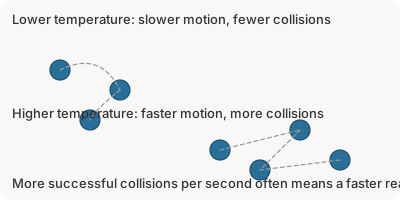
3. Factors — what to say in an exam-style sentence
| Factor | Typical effect on rate | Reason (particle story) |
|---|---|---|
| ↑ Temperature | Faster | Particles move faster → more frequent collisions and more collisions above the activation energy |
| ↑ Concentration (solution) | Faster | More particles in the same volume → more collisions per second |
| ↑ Pressure (gas) | Faster (often) | Closer particles → more collisions per second |
| ↑ Surface area (solid) | Faster | More solid exposed to solution/gas → more collisions at the interface |
| Catalyst | Faster | Lower activation energy → a greater fraction of collisions succeed; not consumed overall in the net equation |
4. Diagram — activation energy (schematic)
The curve below is generic. Reactants (R) and products (P) sit at different energy levels; the hill is the activation energy (). Catalysts lower that hill (not drawn as a second curve here — your textbook may show both).
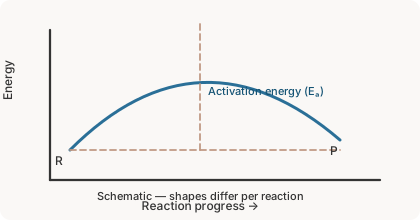
Exothermic vs endothermic: the relative height of R and P changes. The activation energy is always a positive barrier from reactants up to the transition region (the top of the hill in this simplified sketch).
5. Your turn
Q1. Give two safe ways to speed up the reaction of marble chips (calcium carbonate) with hydrochloric acid without changing which acid you use.
Sample answer
Smaller chips or powder (greater surface area); warm the acid (temperature); stir (improves mixing/contact). Any two distinct valid factors.
Q2. Why does increasing concentration often increase rate even if temperature is unchanged?
Sample answer
More reactant particles per unit volume means more collisions per second between reactant particles, so more successful collisions per second.
Q3. A student says: “The catalyst is used up because the reaction speeds up and then finishes.” Correct the misconception.
Sample answer
A catalyst is regenerated by the overall pathway; it speeds the reaction but is not a reactant that gets used up in the net process (it may participate in temporary steps). The reaction finishes when a reactant runs out.