
Appearance
Unit 3 · Natural selection and evidence
Heredity and evolution · Year 10 Science · Science understanding
Topic hub: Overview · Previous: Mendelian inheritance · Next: Practice
This unit is about populations and deep time: how heritable variation and differences in survival and reproduction can reshape trait frequencies — and what evidence supports common ancestry and evolutionary change.
1. What you should be able to do
- State natural selection in your own words (population-level, not “trying” to adapt).
- Name several kinds of evidence used to support evolutionary explanations.
2. Evolution by natural selection
Natural selection is not “nature wants” and not the same as an individual trying to adapt. It is a population-level pattern that emerges when all of the following apply:
- Variation in traits (some differences are heritable).
- Differential survival and reproduction — in a given environment, some heritable variants are more likely to be represented in the next generation.
- Over many generations, favourable heritable traits can become more common; others may decline.
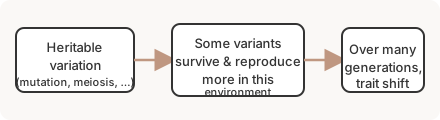
This is a logic chain, not a claim that “nature tries” to improve species. If any ingredient is missing (e.g. no heritable differences), the pattern does not play out as evolutionary change in a population.
New alleles can arise by mutation; meiosis and fertilisation remix existing variation. Together, that is the raw material selection works with — which is why the genetics in Unit 1 and Unit 2 matters for evolution, not only for family trees.
Evidence you should be able to discuss
| Line of evidence | Idea in one line |
|---|---|
| Fossil sequences | Older and younger rocks can show change over time in form, not single “missing links” in a cartoon sense. |
| Homologous structures | Same underlying plan, different jobs (e.g. vertebrate limbs) — fits common ancestry with adaptation. |
| Molecular similarities | Shared DNA/protein patterns across species — another way to test relatedness and deep history. |
| Biogeography | Where species live and how they spread can fit models of origin and change (e.g. islands, continents). |
| Direct observation | Short-term change in populations when environments shift (e.g. antibiotic resistance, industrial melanism). |
Homologous vs analogous
Homologous structures share an underlying body plan from common ancestry, even if they do different jobs now (e.g. bat wing and human arm — same limb bones, different shapes). Analogous structures can look similar and do similar jobs because of similar environments, without a recent shared origin of that structure (e.g. insect wing vs bat wing — both used for flight, different anatomy and evolutionary origins).
Quick check (optional): In one sentence, why are a bat wing and a mouse forelimb often called homologous, while a bat wing and an insect wing are often called analogous?
Sample answer
Bat and mouse share a mammalian limb blueprint from a common ancestor (homologous). Insect and bat wings are similar for flight but built and evolved on different lineages (analogous).