
Appearance
Unit 2 · Inertia and first law
Motion and forces · Year 10 Science · Science understanding
Topic hub: Overview · Previous: Velocity and acceleration · Next: Force, mass and acceleration
Newton’s first law explains why balanced forces feel “normal” — and why friction matters in real life.
Try it first
Use the slider or a preset, then Push (or a preset to set grip and run). Watch how far the puck slides before friction wins. Why does grip change the outcome? Read on to connect that to inertia and the first law.
Interactive: friction and net force (first law)
Adjust surface grip with the slider, or tap a preset (sets grip and starts the run). Use Push to start with whatever grip you chose. The puck moves to the left, then after a short pause a stick strikes it; then it slides right while friction is the only horizontal force — higher grip means a larger slowing net force.
Loading interactive…
1. What you should be able to do
- State Newton’s first law and use inertia in a short explanation.
- Explain why mass measures inertia.
- Recognise that friction and air resistance are real forces that often make net force non-zero when objects slow down.
2. First law — inertia
Newton’s first law: an object maintains its velocity (including rest, ) unless a non-zero net external force acts on it.
- Inertia is the tendency to resist changes in velocity.
- Mass (in kg) is a measure of inertia — a larger mass needs a larger net force for the same acceleration (you will quantify that in Unit 3).
Zero net force is allowed
Constant velocity (including staying still) means acceleration = 0, so net force = 0 along that direction — forces can still be present; they balance.
3. Why moving things seem to “stop by themselves”
On Earth, friction and air resistance usually act on moving objects. If you stop pushing a box, kinetic friction and possibly other forces produce a net force opposite to motion — so the object slows. That is Newton’s first law in action: net force is not zero.
In a thought experiment with no friction and no air (deep space, idealised ice), an object would keep going at constant velocity once started — no “force needed to keep moving.”
On a real surface, higher grip in Try it first means a larger net force opposite motion, so the puck stops sooner — that is still the first law: non-zero net force changes velocity.
4. Common mix-up
“If it’s not moving, no forces act.”
Wrong for most objects on Earth. A book on a table has weight and normal force; they can cancel so net force is zero and the book stays at rest.
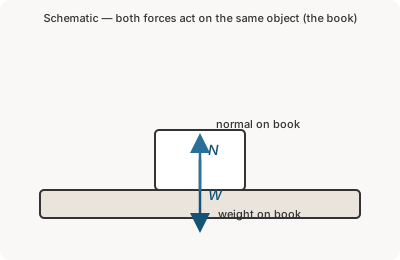
and both act on the book. For third-law pairs (book↔Earth, book↔table), see Interaction pairs (third law).
5. Your turn
Q1. In one sentence, what is inertia?
Sample answer
Inertia is the tendency of an object to keep its current velocity (size and direction), including staying at rest, unless a net external force changes that.
Q2. A hockey puck slides on rough ice and slows down. Does this violate the first law? Explain briefly.
Sample answer
No — net force (friction, maybe air) acts opposite to motion, so acceleration is non-zero and speed changes. The first law says changing motion needs non-zero net force.
Q3. Which has more inertia at rest: a 50 kg student or a 5 kg school bag? Why?
Sample answer
The 50 kg student — larger mass means larger inertia (harder to change velocity by the same amount with the same net force).